Resting Metabolic Rate Test Cost in 2026: Price Guide
For runners and athletes, nutrition decisions are often built around estimates. Fitness watches estimate calories burned, online calculators estimate daily energy needs, and apps use formulas based on age, height, weight and activity level.
Those estimates can be useful, but they are still estimates.
A resting metabolic rate test, usually called an RMR test, takes a different approach. Instead of predicting how many calories your body uses at rest from a formula, the test measures your breathing gases and uses those measurements to estimate your actual resting energy expenditure.
That makes RMR testing attractive to athletes who want a clearer starting point for fueling, body-composition goals or general performance planning.
The first question is often: how much does a resting metabolic rate test cost in 2026?
Current U.S. prices vary significantly. UC Davis Sports Medicine lists a standalone RMR test at $85. George Washington University lists an RMR test at $100. Hospital for Special Surgery lists its 2026 Resting Metabolic Rate Assessment at $210, and Colorado State University also lists its RMR assessment at $210.
That means there is no single national price.
A university exercise-science lab, a hospital performance center and a private metabolic-testing facility may all offer RMR testing, but the appointment length, consultation, equipment and reporting can differ.
The best way to compare providers is not just to ask, “What does the test cost?” but what does the price actually include?
What Is a Resting Metabolic Rate Test?
Resting metabolic rate is the amount of energy your body uses while you are resting.
Even when you are doing nothing physically demanding, your body still needs energy for basic functions such as:
- breathing
- circulation
- brain activity
- maintaining body temperature
- cellular processes
- organ function
An RMR test estimates how many calories your body uses to support those basic functions.
Many professional services use indirect calorimetry. This method measures the oxygen you consume and the carbon dioxide you produce while resting. Those gas measurements are then used to estimate energy expenditure.
Colorado State University describes its RMR assessment as using indirect calorimetry to analyze oxygen consumption and carbon dioxide production.
George Washington University similarly uses gas analysis and has clients recline quietly while breathing through a mouthpiece for about 10 minutes.
The result is more individualized than a basic online calorie calculator.
How Much Does a Resting Metabolic Rate Test Cost in 2026?
Current public prices show a broad range.
UC Davis Sports Medicine: $85 for Resting Metabolic Rate testing.
George Washington University: $100 for an RMR test.
Hospital for Special Surgery: $210 for its 2026 Resting Metabolic Rate Assessment, or $190 for qualifying NYRR members.
Colorado State University: $210 for a Resting Metabolic Rate assessment.
These examples suggest that standalone RMR testing can range from under $100 to more than $200 depending on the provider.
That is not a guaranteed national average.
Private clinics in large cities may charge more, while university labs may offer lower pricing.
What Affects Resting Metabolic Rate Test Cost?
The resting metabolic rate test cost depends on several factors.
The first is the type of facility.
A university laboratory may have different overhead and pricing than a major hospital-based sports-performance center.
The second factor is what is included after the measurement.
Some providers give you a number and a short explanation.
Others include:
- detailed metabolic interpretation
- carbohydrate-versus-fat utilization
- nutrition consultation
- training recommendations
- body-composition testing
- repeat testing
- written reports
- follow-up support
The equipment and staff qualifications can also affect pricing.
A properly performed indirect calorimetry test requires calibrated metabolic equipment and a controlled testing protocol.
What Does an RMR Test Measure?
The main output is an estimate of how many calories your body burns at rest.
Depending on the system, the report may also include information about which fuels your body is using.
UC Davis says its RMR test measures baseline caloric needs and also provides information about fat and carbohydrate utilization.
HSS says its RMR assessment provides resting metabolic rate, resting calorie expenditure, and the percentage of resting energy coming from carbohydrates versus fats.
This can be useful context, but the main value for most people is getting a measured resting-energy estimate rather than relying only on a formula.
RMR vs BMR: Are They the Same?
RMR and BMR are related, but they are not always used in exactly the same way.
BMR, or basal metabolic rate, is usually measured under stricter laboratory conditions.
RMR, or resting metabolic rate, is somewhat easier to measure in practical settings and is more commonly offered by sports-performance laboratories.
In everyday conversation, people sometimes use the terms interchangeably.
But if you are comparing services, check what the facility actually measures.
For most recreational athletes, RMR testing is the more accessible option.
What Happens During the Test?
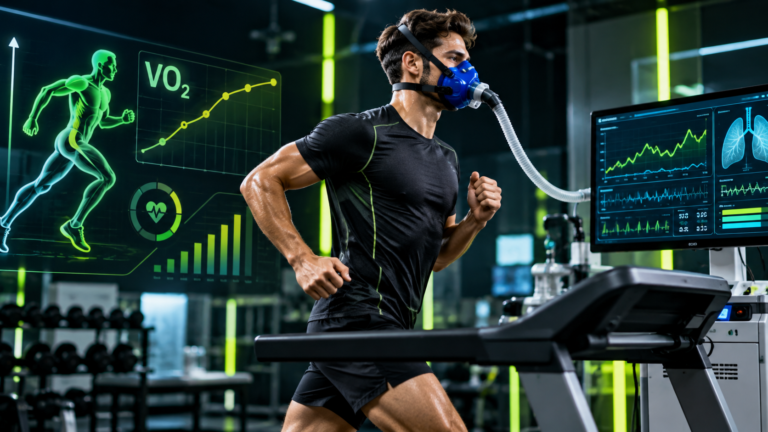
RMR testing is very different from VO2 max testing.
You do not run hard.
You do not perform repeated sprints.
You do not try to reach maximum effort.
Instead, you usually lie down or recline comfortably while breathing through a mask, canopy or mouthpiece.
HSS says participants lie down awake for approximately 30 minutes during its RMR assessment.
George Washington University says its clients recline silently and breathe into a mouthpiece and tube for around 10 minutes while remaining awake and limiting movement.
The goal is to measure your metabolism while your body is calm and resting.
How Long Does RMR Testing Take?
The actual gas measurement may take only 10 to 30 minutes.
However, the full appointment can be longer because of:
- check-in
- health screening
- resting period
- equipment setup
- measurement
- results review
- consultation
When comparing prices, ask how much time is actually included.
A 15-minute measurement with minimal interpretation is different from a 60-minute appointment with a detailed review.
How Should You Prepare?
Preparation is extremely important.
A resting metabolic rate test is supposed to measure your body under resting conditions.
Food, exercise, caffeine and movement can affect the result.
George Washington University recommends fasting for 8 to 12 hours before metabolic testing and suggests morning testing after an overnight fast for the most optimal results.
HSS similarly recommends attending its RMR assessment in the morning after an overnight fast.
Your testing center may also ask you to:
- avoid hard exercise the day before
- avoid caffeine
- avoid nicotine
- stay normally hydrated
- arrive early and rest
- avoid unnecessary movement during the test
Always follow the instructions from the provider you actually book.
Why Does Preparation Matter?
Imagine doing a hard interval workout immediately before the test.
Your body would still be recovering.
Heart rate, breathing and energy use could be higher than normal.
The measurement might not represent true resting conditions.
The same issue can happen after eating a large meal because digestion requires energy.
If you plan to repeat RMR testing several months later, try to reproduce similar conditions.
That makes comparison more useful.
Is RMR More Accurate Than an Online Calorie Calculator?
An online calorie calculator usually predicts resting metabolism using a mathematical equation.
These formulas use variables such as:
- age
- sex
- height
- weight
They can provide a reasonable starting point for many people.
But they do not directly measure your breathing gases.
An indirect calorimetry test collects individual metabolic data.
That is its main advantage.
However, a measured RMR is not a perfect prediction of how many calories you should eat every day.
Your total daily energy expenditure also depends on activity.
RMR Is Not Total Daily Calorie Burn
This distinction is important.
Your resting metabolic rate is only one part of your total energy expenditure.
You also use energy for:
- walking
- training
- work
- daily movement
- digestion
- household activity
- recovery
So if your RMR is 1,700 calories per day, that does not automatically mean you should eat 1,700 calories per day.
Your true daily energy needs may be much higher.
For runners training frequently, exercise expenditure can make a major difference.
RMR should be viewed as a baseline, not a complete nutrition prescription.
RMR Testing for Runners
Runners can find RMR data useful when they are trying to understand fueling needs.
High training volume can make energy planning difficult.
A runner may underestimate how much energy the body needs at rest before even adding workouts.
However, one RMR number should never be treated as permission to aggressively restrict food.
Running performance depends on adequate energy availability, recovery and consistent training.
If nutrition decisions become complicated, working with a qualified sports dietitian can be more useful than relying on one metabolic number alone.
RMR Testing for Sprinters
Sprinters typically have lower weekly aerobic volume than endurance runners, but energy needs still matter.
Strength training, speed work, recovery and muscle maintenance all require fuel.
A sprinter interested in changing body composition may use RMR testing as one data point.
But sprint performance is not determined by resting metabolism.
Acceleration, force production, technique, strength and maximum velocity are far more specific performance measures.
RMR testing is better thought of as a nutrition and energy-planning tool.
Can RMR Help With Weight Loss?
RMR testing can provide a more individualized estimate of resting energy use.
That may be helpful when someone is trying to understand why a generic calorie calculator seems unrealistic.
But the test does not guarantee weight loss.
Body weight changes are influenced by many factors, including:
- energy intake
- activity
- training load
- sleep
- stress
- fluid balance
- adherence
- medical factors
An RMR result should not be treated as a crash-diet target.
For athletes, aggressive calorie restriction can reduce training quality and recovery.
Can RMR Help With Weight Gain or Muscle Gain?
Potentially.
Someone trying to gain muscle may use RMR as part of a broader estimate of daily energy needs.
A measured baseline can make calorie planning more informed.
But again, RMR is only the resting component.
Strength training, daily activity and individual response still matter.
If your goal is muscle gain, pairing RMR with body-composition testing can provide more useful context.
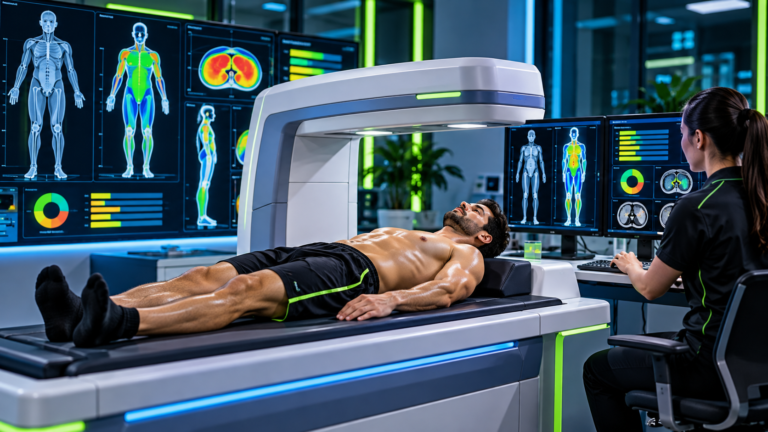
RMR Testing vs DEXA Scan
These tests answer different questions.
A DEXA scan estimates body composition.
It can show:
- fat mass
- lean mass
- regional body composition
- visceral fat
An RMR test estimates resting energy expenditure.
They are complementary.
George Washington University offers a DXA + RMR package for $240, compared with $100 for RMR alone.
UC Davis also combines RMR with other body-composition and performance services in broader packages.
For someone changing both nutrition and body composition, combining the two can make sense.
If you also want to understand changes in body fat and lean mass, read our guide on DEXA Scan Cost in 2026.
RMR Testing vs VO2 Max Testing
VO2 max testing measures aerobic capacity during progressively harder exercise.
RMR testing measures energy use while resting.
The experience is almost the opposite.
VO2 max is physically demanding.
RMR testing is quiet and passive.
HSS lists both as separate services: $210 for RMR and $315 for VO2 max-only testing in 2026.
Choose the test based on the question you want answered.
If you want aerobic fitness data, choose VO2 max.
If you want resting calorie expenditure, choose RMR.
RMR vs Exercise Metabolism Testing
Exercise metabolism testing measures how much energy you use during increasing exercise intensities.
It may also examine fat and carbohydrate use.
UC Davis lists exercise metabolism testing at $175 initially, compared with $85 for RMR.
These services can be combined for a more complete picture.
RMR estimates resting energy needs.
Exercise testing estimates energy expenditure while training.
For endurance athletes, both may be useful when planning fueling.
What About Sports Nutrition Packages?
Some facilities combine metabolic testing with nutrition consultation.
HSS lists a 2026 Nutrition Blueprint package at $510, which combines a nutrition evaluation with a Resting Metabolic Rate assessment.
This is significantly more expensive than a standalone test.
But it also provides a different service.
The value depends on whether you need professional interpretation and nutrition planning.
If you only want your resting metabolic rate number, a lower-cost standalone test may be enough.
Does Insurance Cover RMR Testing?
Performance-focused RMR testing is often self-pay.
George Washington University explicitly states that it does not accept insurance for its RMR service.
That does not mean every medically ordered metabolic test is never covered.
Clinical testing for a medical reason is different from elective sports-performance testing.
Before booking, ask:
- Is this test self-pay?
- Is insurance accepted?
- Is a referral required?
- Is the service considered medical or performance testing?
Do not assume coverage simply because the test takes place in a hospital.
Is a More Expensive RMR Test More Accurate?
Not automatically.
Price can reflect many things besides accuracy.
For example:
- location
- appointment length
- staff time
- consultation
- facility overhead
- equipment
- brand reputation
A properly run $85 university test may provide useful results.
A $210 hospital test may offer a more comprehensive experience.
The better choice depends on what you need.
How Often Should You Repeat RMR Testing?
There is no reason for most people to test every few weeks.
Resting metabolism can change with:
- body weight
- lean mass
- training
- dieting
- illness
- major lifestyle changes
If your body composition or training changes significantly, repeating the test after several months may be useful.
For athletes, repeat testing can be more informative when paired with measurable changes in body composition or training volume.
Can Your RMR Be “Slow”?
People often describe themselves as having a “slow metabolism.”
The reality is more complicated.
Resting metabolic rate varies between individuals.
Important influences include:
- body size
- lean mass
- age
- sex
- genetics
- hormones
- energy intake
- training status
A measured RMR can show whether your resting energy expenditure is higher or lower than expected, but interpretation should be careful.
One test should not be used to diagnose a medical problem.
If you have concerns about thyroid function, unexplained weight changes or other symptoms, speak with a qualified healthcare professional.
What Makes a Good RMR Testing Center?
Before booking, ask:
Do you use indirect calorimetry?
How long is the measurement?
Do I need to fast?
Do I receive a written report?
Does someone explain the result?
Is fuel utilization included?
Is the equipment calibrated before testing?
Can I repeat the same protocol later?
What is the full resting metabolic rate test cost?
These questions help you compare the service rather than simply comparing the price.
Is RMR Testing Worth the Money?
For some athletes, yes.
It can be useful if you:
- want a measured baseline instead of a formula
- are planning a structured nutrition phase
- want to combine metabolism and body-composition tracking
- work with a sports dietitian
- plan to repeat testing
It may be less useful if you:
- only want a curiosity number
- will not change anything based on the result
- already have a nutrition plan that works well
- expect the test to tell you exactly how many calories to eat every day
The best test is one that changes a useful decision.
Frequently Asked Questions
How much does an RMR test cost in 2026?
Current public examples range from $85 at UC Davis and $100 at George Washington University to $210 at Hospital for Special Surgery and Colorado State University.
What affects resting metabolic rate test cost?
Resting metabolic rate test cost varies by provider, location, equipment, appointment length and whether consultation or additional testing is included.
Is RMR testing accurate?
Indirect calorimetry directly measures breathing gases and provides an individualized estimate of resting energy expenditure, but results still depend on proper preparation and testing conditions.
How long does an RMR test take?
The measurement itself may last around 10 to 30 minutes depending on the provider, with extra time for preparation and results review.
Do I need to fast?
Many providers recommend an overnight fast or approximately 8 to 12 hours without food before testing. Follow the instructions from your specific laboratory.
Is RMR the same as calories burned in a day?
No. RMR measures resting energy expenditure. Total daily energy expenditure also includes exercise, daily movement and digestion.
Is RMR testing useful for runners?
It can help establish a baseline for nutrition and fueling, especially when combined with training-volume and body-composition information.
Can RMR testing tell me exactly how much to eat?
No. It gives you a resting baseline. Daily intake decisions require additional information about activity, goals and individual needs.
The Bottom Line
The resting metabolic rate test cost in 2026 varies considerably by provider.
Current public pricing includes $85 at UC Davis, $100 at George Washington University, $210 at Hospital for Special Surgery and $210 at Colorado State University.
The cheapest option is not automatically the best, and the most expensive option is not automatically more accurate.